
ECD technology
A subtractive approach to separating dissolved metals and salts from complex industrial wastewater.
Most treatment systems work like coffee filters, trapping contaminants on the membrane surface until fouling causes performance decline.
Electro-Ceramic Desalination (ECD) works more like a kidney, continuously separating dissolved metals and salts into a concentrated side stream so treatment performance remains stable.
ECD uses ceramic membranes and an applied electrical field to actively transport dissolved ions out of wastewater as it flows through the system. Instead of relying on pressure, chemical precipitation or ion exchange, the electrical field drives targeted ions across the membrane into a small, concentrated side stream.
Because the membranes are ceramic rather than polymeric, they tolerate harsh industrial conditions including low pH conditions, foulants, oxidizers, solvents and complex wastewater chemistry. The result is stable treatment performance in streams where conventional filtration systems struggle or require significant pre-treatment.
Capabilities
ECD technology is designed to treat complex industrial wastewater streams that challenge conventional filtration systems.
Operational impact
Get control over your complex industrial wastewater streams.
ECD gives operators a more direct way to manage complex or increasingly constrained wastewater streams. By actively separating dissolved salts and metals into a concentrated side stream using durable ceramic membranes, ECD reduces the need for escalating chemicals, workarounds and constant intervention. The result is stable treatment performance operators can run with greater confidence, even as wastewater conditions change.
Why ECD wins
Why ECD technology is proving itself at the edge where conventional treatment fails.
01
Actively separates ions instead of trapping contaminants in filters
Conventional membrane systems trap contaminants on the membrane surface until fouling causes performance to decline. ECD actively separates dissolved ions into a concentrated side stream, preventing contaminant buildup inside the system.
02
Subtractive separation instead of escalating chemical treatment
Traditional treatment often relies on increasing chemical dosing, precipitation or ion exchange as wastewater becomes harder to manage. ECD removes dissolved ions electrically, reducing the need for chemical workarounds.
03
Durable ceramic membranes instead of fragile polymer materials
Polymer membranes degrade in harsh industrial environments including oxidizers, solvents and acidic pH conditions. ECD uses robust ceramic membranes designed to withstand demanding wastewater chemistries.
04
Stable separation instead of gradual performance decline
As fouling accumulates, conventional filtration systems often lose performance and require frequent intervention. By continuously removing dissolved ions, ECD maintains stable treatment performance even as wastewater conditions evolve.
Where ECD works
ECD integrates with existing treatment systems to stabilize performance, extend operating limits and unlock additional value from industrial wastewater streams.
It can be deployed alongside common treatment technologies to improve system performance and enable new operating outcomes:
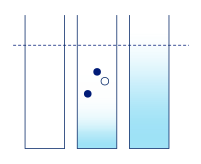
Chemical precipitation to reduce treatment volumes, stabilize metal concentrations and improve reaction kinetics.
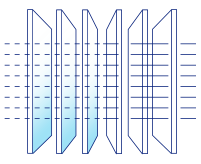
Reverse osmosis systems to recover more water from high-fouling or scaling concentrate streams.
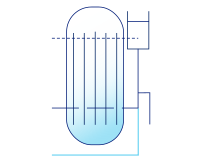
Evaporators to lower energy demand by pre-concentrating dissolved contaminants upstream.
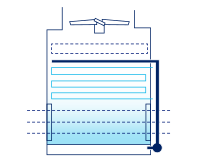
Cooling towers to increase cycles of concentration while reducing chemical dosing.
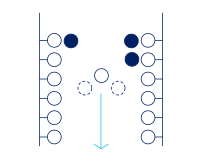
Ion exchange systems to reduce regeneration frequency and maintain discharge compliance.
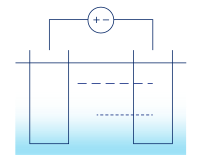
Electrowinning systems to increase metal concentrations required for efficient metal recovery.


Resources
Explore Membrion resources to gain insights on solving complex water challenges.
Overcoming silica constraints in high-recovery water treatment
Silica is one of the biggest barriers to high-recovery water…Treating concentrated metal wastewater in semiconductor manufacturing
Treating concentrated metal wastewater is critical in semiconductor manufacturing. This…Optimizing evaporation pond management in mining operations
Evaporation ponds are costly, land-intensive, and increasingly difficult to manage…