
Treating concentrated copper wastewater without expanding the footprint
Semiconductor copper wastewater from electrodeposition tools can arrive at high concentration, low pH and with significant variability. See how Lam Research partnered with Membrion to treat it onsite with electro-ceramic desalination (ECD) — in a footprint of under 35 square feet — and continue to increase throughput while managing their complex wastewater.
Get the case study
Get the full case study, including process flow diagrams, example parameters, background on operational impacts, and key learnings for the semiconductor industry.
Key takeaways
- Electrodeposition wastewater can contain copper up to 60 g/L at pH 0 to 2, with concentrations swinging by roughly 40 percent depending on tool recipe.
- Chemical precipitation can struggle with high, fluctuating metal concentrations, while conventional ion exchange is not designed for high-loading or multi-metal streams.
- Electro-ceramic desalination (ECD) moves dissolved copper across ceramic membranes into a separate concentrate stream, resulting in 60% wastewater recovery by volume that did not need to be handled offsite.
- At Lam Research’s Tualatin campus, the system treated up to 250 gallons per day within a footprint of less than 35 square feet while maintaining effluent copper below 100 ppm despite significant feed variability.
- Continuous optimization under a water-as-a-service model improved copper removal rate, water recovery and daily treatment capacity with no additional capital investment or disruption to ongoing operations.
Why copper wastewater constrains semiconductor capacity
Demand for advanced packaging has pushed electrodeposition tool utilization higher, and every additional run generates more concentrated copper wastewater. For many facilities, wastewater treatment capacity can become the constraint on production throughput.
Why conventional treatment struggles
Chemical precipitation can struggle with high, fluctuating metal concentrations, while conventional ion exchange is not designed for high-loading or multi-metal streams. Neither is well suited to the combination of high copper concentration, low pH and variability present in this wastewater.
The constraint at Tualatin
Lam Research’s 52-acre Oregon campus had extremely limited space available for additional storage or treatment, and was trucking concentrated copper wastewater offsite at variable and rising cost. Any solution had to be compact, retrofit-friendly and able to manage changing wastewater conditions without requiring a facility expansion.
How ECD treats high-strength copper streams
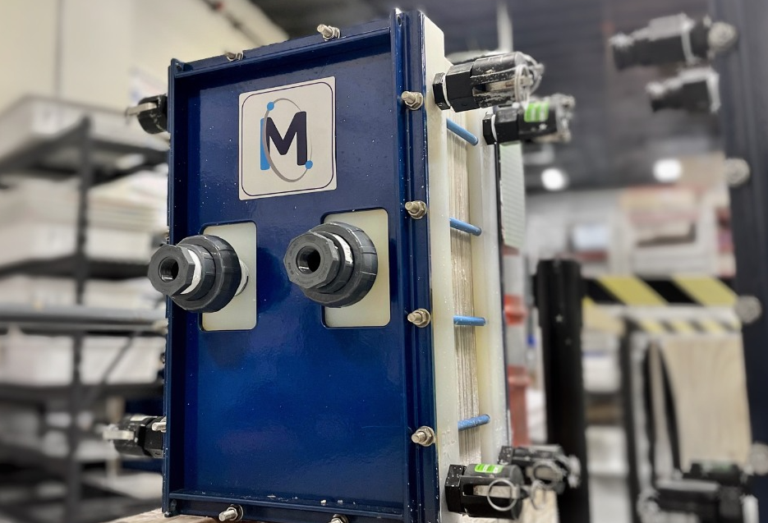
Electro-ceramic desalination is a low-pressure electrochemical process that actively moves dissolved ions through ceramic membranes into a small-volume concentrate stream. The system runs in sequential automated batches, and batch time automatically adjusts to copper concentration. Each batch continues until the target product quality is reached, regardless of the starting chemistry. This produces predictable effluent quality even as feed conditions change.
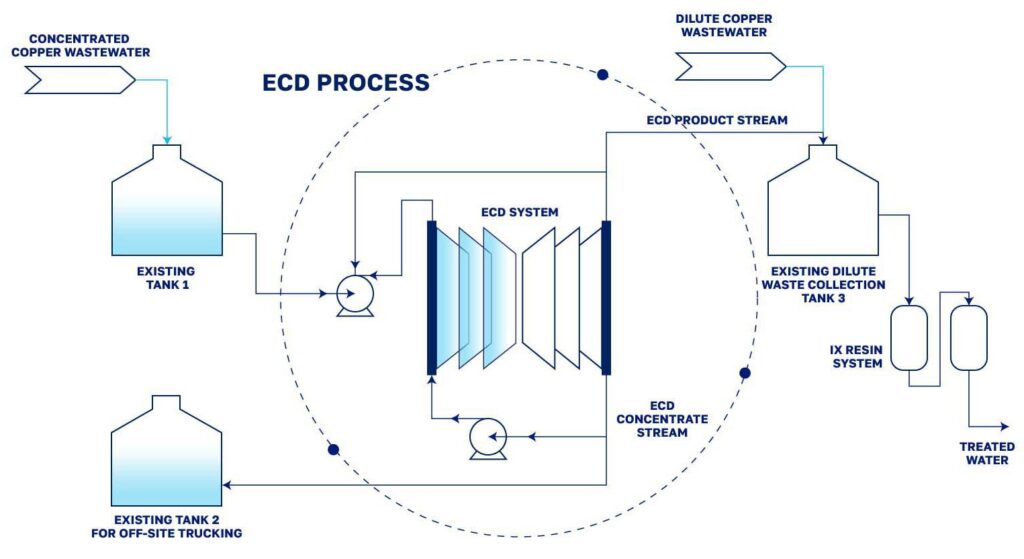
The result
The system treats up to 250 gallons per day within a footprint of under 35 square feet, maintaining treated copper below the 100 ppm requirement across highly variable feed conditions. Roughly 60 percent of the wastewater volume was recovered as treated water, reducing the volume requiring off-site handling by a similar magnitude, and cost per gallon fell 35 percent.
What changed over the deployment
As a first-of-its-kind installation, the system generated operational insight that fed back into its own performance, delivered under a water-as-a-service model without capital requests or downtime. Following the deployment, ECD was incorporated into Lam Research’s engineering guidance as a recommended solution for this wastewater stream.
Frequently asked questions
How is copper removed from semiconductor electrodeposition wastewater?
Conventional approaches use chemical precipitation or ion exchange, both of which can struggle with high-strength, variable copper wastewater. ECD uses an applied electrical field to move dissolved copper across ceramic membranes into a separate concentrate stream, which keeps effluent quality stable as feed chemistry changes.
Can treating on-site reduce wastewater being trucked away?
Yes, within a compact footprint. At Tualatin, a system treating up to 250 gallons per day fits in under 35 square feet and recovers roughly 60 percent of the wastewater volume as treated water, reducing the volume requiring off-site handling by a similar amount.
How does ECD handle variable feed chemistry?
Each batch runs until the target product quality is reached, regardless of starting chemistry. At Tualatin, feed copper concentrations varied significantly, yet treated effluent remained below the required 100 ppm limit throughout operation.
How does the water-as-a-service model benefit semiconductor manufacturers?
Membrion’s ECD technology was delivered under a water-as-a-service model, which shifts expense from a capital investment to an operational one, with clear parameters and goals. This model incentivises performance, deploys quickly, and reduces upfront risk.
Get the full case study
Get the full case study, including process flow diagrams, example parameters, background on operational impacts, and key learnings for the semiconductor industry.
Resources
Explore Membrion resources to gain insights on solving complex water challenges.
When everything is possible, what is valuable?
For decades it’s been technically possible to treat almost any…The real opportunity in resource recovery
Resource recovery doesn’t get adopted as a sustainability story. It…Overcoming silica constraints in high-recovery water treatment
Silica often sets the recovery ceiling in reverse osmosis systems…